Nige said: The one factor I feel is important does not seem to have been mentioned up to now. Face shovels are intended for fast loading of large quantities of any "previously loosened" material, be that by blasting, ripping, or the nature of the material itself (the example above regarding corn is a good one). This limits their usefulness significantly in my opinion, because in general they won't dig in-situ material, at least not efficiently anyway.. Click to expand... Check out Mike Mulligan by Virginia Lee Burton. Greatest piece of children's literature ever. "Four corners neat and square." Dug the cellar for the new Town Hall in Popperville.
Small faceshovel versus smaller conventional excavator
Started by Tones67 replies
Willie BSenior Member#21 David JonsonNew Member#22 Good question and a sharp observation. Face shovels actually do have those advantages, but they’re generally used on larger mining-class excavators because their design makes the most sense at that scale. On smaller machines, a few issues limit their practicality: Geometry and stability: Small excavators don’t have the counterweight or boom geometry to handle the forward-facing leverage of a face shovel efficiently you’d lose breakout force and risk tipping on uneven ground. Visibility and control: Operators on smaller rigs rely heavily on direct sight lines; a face shovel setup blocks a lot of that view. Versatility: Standard backhoe (hoe) configurations are far more flexible for general digging, grading, and loading the kind of mixed work smaller machines do daily. Market demand: Quarries and tunneling operations that could use them typically step up to medium or large mining gear, where face shovels already exist. That said, your logic about tight-space efficiency and easier maintenance is spot-on if a manufacturer ever engineered a compact, well-balanced face shovel attachment, it could have a niche following in tunneling or specialized loading.
Welder DaveExpert#23 Would think excavators have much higher breakout force and can take as big or as little a bite as necessary for the conditions. Much faster to reposition if small bites are required.
TonesSenior Member#24 All of that is correct Dave but equally there are plenty of situations where a shovel would be superior and more cost efficient. One job I had was running a track mounted crusher, loading it with a excavator and working alone. Sitting on a bench feeding the crusher then having to come down a clear the heap from the end of the belt was a PITA, a job were a shovel would have made complete sence to use.
Shimmy1Super User#25 Welder Dave said: Would think excavators have much higher breakout force and can take as big or as little a bite as necessary for the conditions. Much faster to reposition if small bites are required. Click to expand... Excavators are designed to pull the bucket towards the machine. Cylinders all extend to load bucket. Any operation mimicking a face shovel is going to go against the principals of physics. Face shovels have the cylinders arranged so they are pushing. Anyone that has ever operated an excavator with the bucket backwards knows it's not production work, it's merely situational.
Welder DaveExpert#26 Doing precision work an excavator is superior because you can see exactly what the bucket is doing. I can't imagine you could do drainage work very well with a face shovel.
John C.Super User#27 All the Japanese excavators were first designed as face shovels. That's why they all have the auxiliary valve spool installed in their main control valves that everyone used for auxiliary functions like thumbs and such. This was from the Hitachi and Komatsu factory reps in the late eighties.
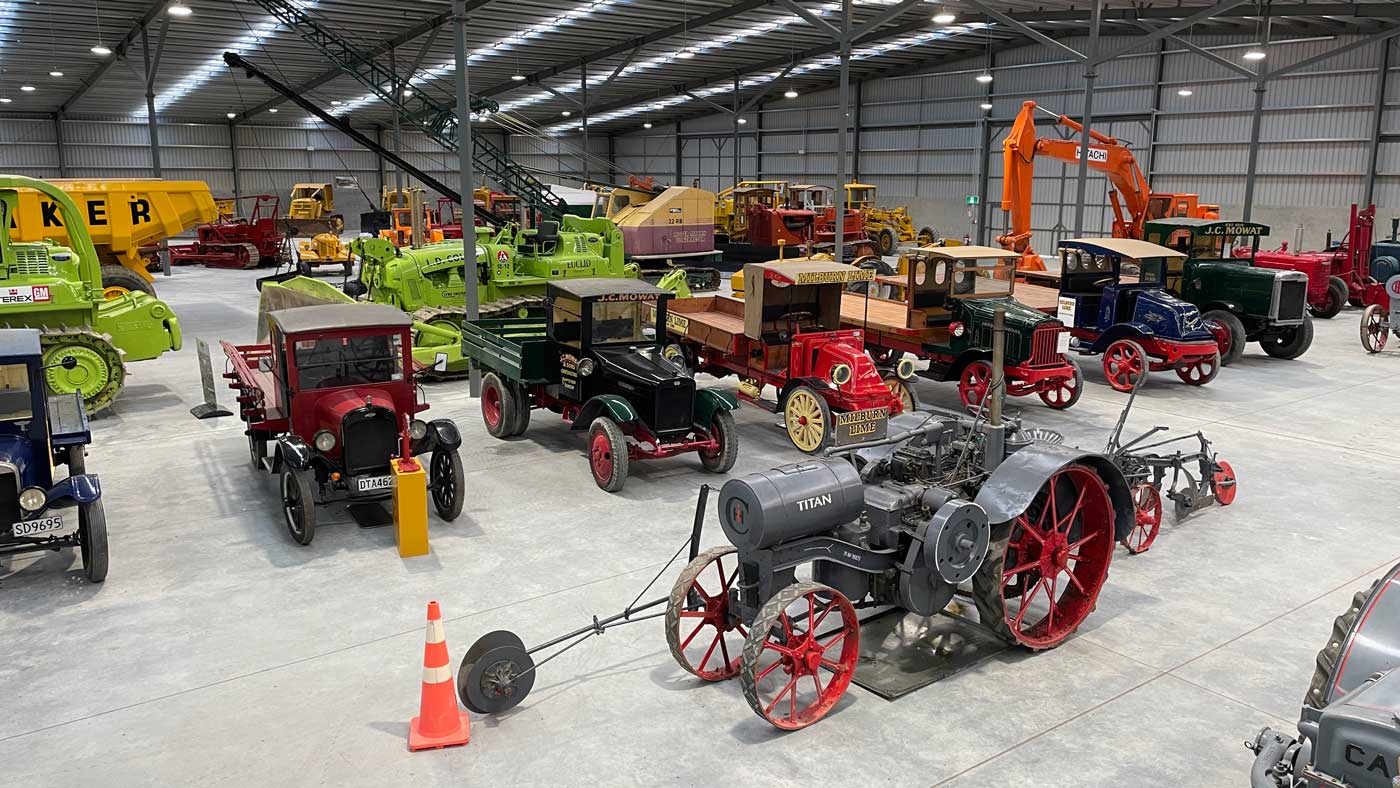
TonesSenior Member#28 Welder Dave said: Doing precision work an excavator is superior because you can see exactly what the bucket is doing. I can't imagine you could do drainage work very well with a face shovel. Click to expand... Strange you say this Dave. Another job I was involved with was installing 800m of 2.5metre pipe in narrow easement. The only way it could be done was dig, lay and backfill. The entire length of that job was done with the bucket reversed on hoe. In places the hoe couldn't swing around because the boom was to long, with a shovel it would have been a peace of p*^s In the background is the digger that was used and the only left in the world. https://www.vttourism.co.nz/__data/assets/image/0010/662653/Roger-Mahan-Heritage-Centre-face.jpg
Welder DaveExpert#29 In some cases an excavator isn't the best option but when I look at pics. like Shimmey's drainage work I can't see it being done that well with a face shovel. If you have a trench with a flat bottom makes it easier if you just have to put the bucket on the bottom to extend the trench.
TonesSenior Member#30 My point is that it's all horses for courses, some jobs can be done a better than another. As it was with the old rope machines were booms were interchanged to suit the task. Never in their wildest dreams would the old fellas send a drag line out to dig a sewer main up a street, that was a hoe job.
Shimmy1Super User#31 Tones said: Never in their wildest dreams would the old fellas send a drag line out to dig a sewer main up a street, that was a hoe job. Click to expand... Not so fast, in my neck of the woods, our city sewers were installed in the 30s, and some of it is over 25' deep. History here says they dug most of it with draglines.
TonesSenior Member#32 On the few occasions when you had a proactive municipality no doubts.
.RC.Junior Member#33 Front end loaders probably saw the end of the small face shovels. Although it seems civil engineering seems to think backhoe style excavators can do anything and everything cheaper and more efficiently then anything else and have forgotten that things like graders can slope banks and dig V drains far cheaper, or loaders can load trucks more efficiently.
Welder DaveExpert#34 Clark figured the 675 loader was faster carrying material directly to the hopper than loading trucks. It was painfully slow with a full bucket going up an incline in their own promotional video.
TonesSenior Member#35 .RC. said: Front end loaders probably saw the end of the small face shovels. Although it seems civil engineering seems to think backhoe style excavators can do anything and everything cheaper and more efficiently then anything else and have forgotten that things like graders can slope banks and dig V drains far cheaper, or loaders can load trucks more efficiently. Click to expand... Yet hoes and shovels can load trucks at half the cost of wheel loaders and that's how they cornered the market for these applications. Loaders still have a place were agility is a requirement
Shimmy1Super User#36 .RC. said: Although it seems civil engineering seems to think backhoe style excavators can do anything and everything cheaper and more efficiently then anything else and have forgotten that things like graders can slope banks and dig V drains far cheaper, or loaders can load trucks more efficiently. Click to expand... Very rarely can a blade get down in the ditches around here with our soil types. It's the same reason why we HAVE to have LGP dozers.
Willie BSenior Member#37 We are kind of rural here. I feel excavators srrived here years later than in more populated areas. We have played out gravel pits all over Vermont with rusted cable shovels. I'd guess shovels preceeded track hoes by 80 or even more years. First excavators I saw were in 1979 when Larry (Boob) White bought two to dredge the local rocky brooks after a major storm event. Both were John Deere a 690 & a 790. I was in awe of them. Prior to that construction, as in houses were dug with either crawler tractors, or other makeshift methods. One old gent proudly showed me a 3 point hitch scoop on a Ford 9N tractor. We started seeing backhoes on wheel tractors mid 1960s.
hvy 1tonJunior Member#38 oarwhat said: So they have an impressive machine loading trucks. With a Skidsteer feeding it lol. Click to expand... The skidsteer is just cleaning up around the air pipes and edges. The excavator is digging into a pile of corn that's probably 100' tall.
skyking1Super User#39 hvy 1ton said: The skidsteer is just cleaning up around the air pipes and edges. The excavator is digging into a pile of corn that's probably 100' tall. Click to expand... We call that pimping for the hoe. I've done it with a small dozer. Jjust cleaning up keeping the immediate road okay at the load face area. There's a grader out there taking care of the rest of the roads.
nicky 68aJunior Member#40 The smallest face shovels I recall in action were Cat 235’s back in the late 80’s and a few 245’s. Obviously,there were many special application smaller models for skimming the tiny coal seams we suffer from in the UK. On a different note,some were forward dump only as opposed to clamshell